
Do different methods for measuring implant stability give the same answer?
May 28, 2026
A recent retrospective method-comparison study by Jung et al. (2026), “Clinical agreement between scale-aligned damping capacity and resonance frequency analyses for implant stability,” evaluated how different measurement technologies compare in a clinical setting.
The study included 890 implants from 600 patients and provides valuable insight into the agreement between resonance frequency analysis (RFA) and damping capacity analysis (DCA).
For those interested in the full publication, the article abstract is available in our scientific database, where we curate clinical evidence related to implant stability. The original publication can also be accessed through the Journal of Periodontal & Implant Science.
Understanding the methods
Although both RFA and DCA are used to assess implant stability, they are based on fundamentally different principles.
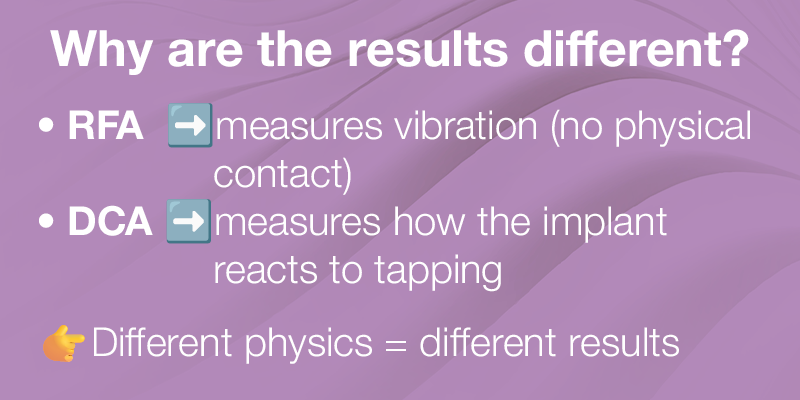
- Resonance frequency analysis (RFA) measures the stiffness of the implant–bone interface by analysing resonance frequency, presented as an ISQ value on a scale from 1 to 99.
- Damping capacity analysis (DCA) evaluates how the implant responds to a small mechanical impact, reflecting the degree of mobility or energy dissipation in the system.
While both methods aim to describe implant stability, they approach it from different physical perspectives – stiffness versus mobility.
Recently, scale-aligned DCA devices have been introduced to approximate the ISQ scale used in RFA. This development aims to improve clinical usability by allowing measurements without removing prosthetic components, while presenting results in a familiar numerical range.
However, this also raises an important question: if different methods report values on a similar scale, do they provide the same clinical information?
What was investigated in the study
The study included:
- 890 implants placed in 600 patients
Measurements taken at multiple time points during healing and follow-up
Comparison between:- one RFA device
- two DCA devices (with outputs aligned to an ISQ-like scale)
The authors evaluated:
- Correlation between the methods (do they move in the same direction?)
- Agreement (do they give similar values?)
- Diagnostic accuracy, using an ISQ threshold of 70
- The influence of clinical factors such as insertion torque and bone augmentation procedures
Key findings
1. Moderate correlation between RFA and DCA
The study found a moderate positive correlation between RFA and DCA measurements.
This means that:
- When stability increases, both methods tend to reflect this trend
- However, the relationship is not strong enough to consider them interchangeable
The two DCA devices showed a stronger correlation with each other than with RFA, reflecting their shared measurement principle.
Interpretation:
Different methods may follow similar trends, but they do not necessarily provide the same clinical information.
In addition, DCA is influenced by how the measurement is performed. As the method relies on a mechanical tapping event, factors such as the point of contact and direction of application can affect the recorded value, making the measurement more operator-dependent.
Furthermore, the reported values are derived from dynamic response characteristics – such as contact time and rebound – and transformed into device-specific stability indices through internal scaling procedures.
2. Systematic differences between methods
A key finding was the presence of systematic discrepancies between DCA and RFA.
Specifically:
- DCA measurements tended to overestimate implant stability in lower stability ranges, compared to RFA
Clinical relevance:
This is particularly important during the early healing phase or in challenging cases, where identifying low stability is critical for treatment decisions.
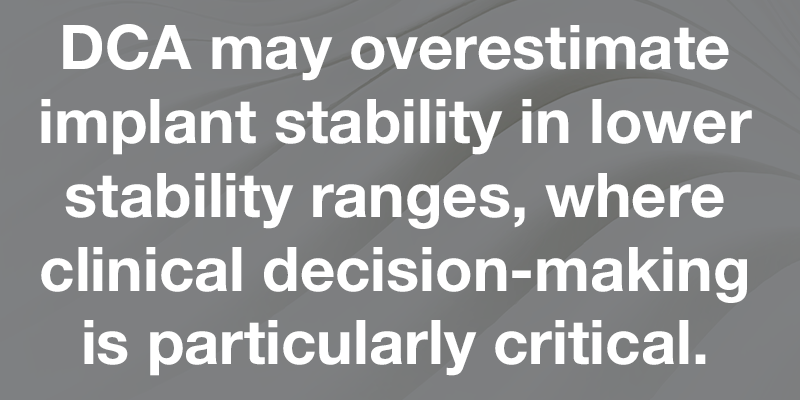
The study also showed that this discrepancy follows a proportional pattern, with DCA tending to overestimate stability at lower values and underestimate it at higher levels.
3. Only fair diagnostic accuracy
Using an ISQ threshold of 70, the DCA devices showed fair diagnostic accuracy. This threshold is commonly used in clinical practice to support decision-making around loading protocols and healing time.
You can read more about how ISQ ranges are interpreted in clinical practice in our article on the traffic light concept.
This suggests that:
- DCA can provide useful information
- But may not reliably match RFA when used as a decision threshold
The relatively low specificity indicates a risk of false-positive classification, meaning implants with lower stability may be interpreted as sufficiently stable when using DCA-based thresholds.
4. Influence of clinical factors
As expected:
- Initial stability was influenced by insertion torque and simultaneous bone augmentation procedures
- These differences reduced over time as healing progressed
This reinforces the importance of careful interpretation of stability measurements during the early phase.
What does this mean in practice?
This study highlights an important distinction:
Correlation does not equal agreement.
This means that even if two methods follow the same trend, they may not provide the same value for a given implant – and therefore may not lead to the same clinical decision.
In practice, this means that different methods may:
- Provide different absolute values
- Behave differently in clinically sensitive situations
The observation that DCA may overestimate stability in lower ranges is particularly relevant, as this is where clinicians are often making the most critical decisions regarding loading protocols.
These findings suggest that DCA may be best used as a complementary tool rather than a direct substitute for RFA, particularly in clinically sensitive situations.
A broader perspective
Objective measurement remains key to improving predictability in implant treatment. However, understanding the characteristics and limitations of each method is equally important.
Resonance frequency analysis, expressed as ISQ, has the advantage of:
- A well-established scale
- Extensive clinical documentation
- Defined reference ranges supporting decision-making
At the same time, studies such as this underline that:
- Not all measurement technologies can be used interchangeably
- Interpretation should always consider how the data is generated
- RFA remains the more trusted method
- Use DCA as supportive information – not as the only decision tool
Conclusion
Different methods for measuring implant stability may follow similar trends over time, but do not necessarily provide the same clinical insight. This study suggests that while DCA devices show acceptable agreement with RFA, systematic differences exist – particularly in lower stability ranges where accurate assessment is most critical.
For clinicians, the key takeaway is clear: Understand your measurement method, and interpret the results within its context.

Add comment